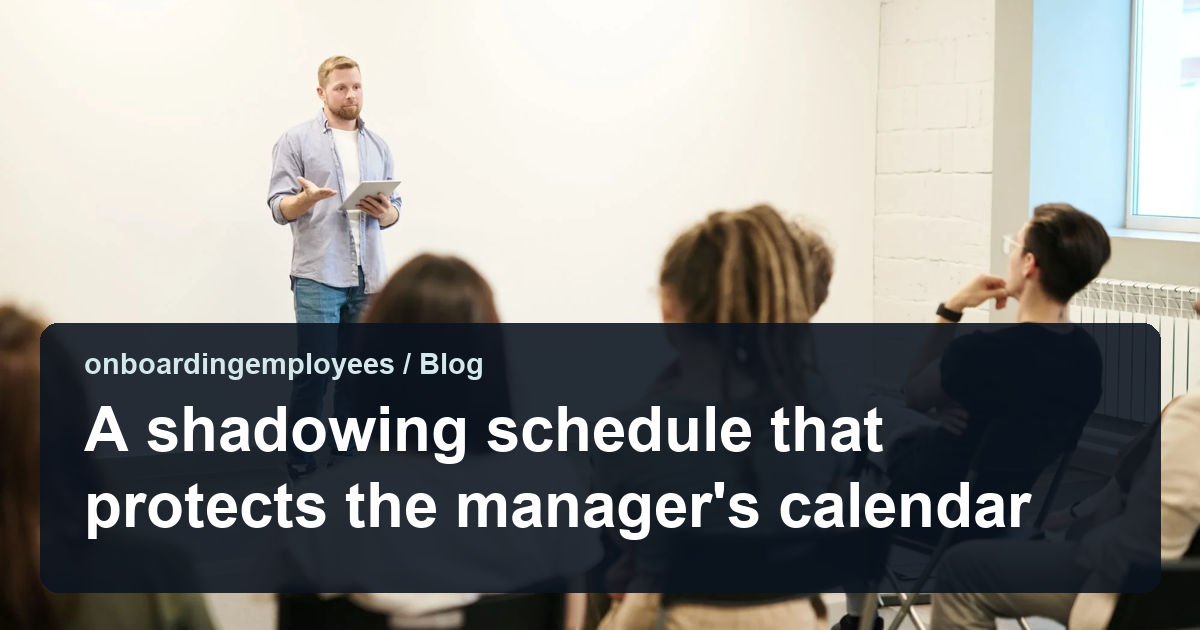
Decide what must be observed live
List the tasks that carry real risk if they are learned by trial and error. Client correspondence, payment changes, access requests, and any task with a legal deadline belong on that list. Separate them from tasks that can be learned from a written guide and a sample. The observation list should be short enough to finish within the first week, not a copy of the full job description.
Ask the owner of each task what a new assistant usually gets wrong. Their answer is more useful than a generic onboarding checklist because it points to the actual judgment calls. Record the specific mistake and the check that catches it. Build each shadowing session around those two points so the time has a clear purpose.
Build a short observation calendar
Put the sessions on the calendar before the start date. Use short blocks of thirty to forty-five minutes instead of half-day shadowing marathons. Leave at least fifteen minutes between sessions for notes and questions. A compact calendar is easier to protect when the manager's week fills up with client work.
Name a backup observer for each session. The backup can be a senior assistant, a team lead, or another manager who performs the task the same way. Give the backup the same session outline and the same authority to answer process questions. A cancelled session should not become a lost day of onboarding.
Give the shadow a job during the session
Give the new assistant a specific observation task. Ask them to write the inputs, the decision points, and the finish check while the owner works. At the end of the session, have them read the notes back and correct anything they misunderstood. This turns a passive call into evidence that the process was actually transferred.
Collect the notes in one place and compare them with the written procedure. Where the notes and the procedure disagree, decide which one is correct. Update the procedure before the next session rather than asking the new assistant to remember a verbal correction. The observation record becomes the first version of the role's working guide.
Keep the manager's calendar from collapsing
Do not book the manager for every session. Use the task owner or a senior assistant for routine demonstrations and reserve the manager for priority setting, client context, and exceptions. Group the manager's sessions into two blocks during the week. That protects focus time and makes the manager's attendance more deliberate.
Tell the rest of the team which sessions are closed and why. A visible block prevents the usual pattern where a meeting is booked over the onboarding session and then cancelled. If a session must move, move it to the backup observer rather than deleting it. The calendar should show the handoff, not a gap.
Convert observations into a written procedure
After each session, update the task procedure with the steps the observer actually saw. Add the exception the owner described and the check that catches it. Keep the document short enough to use during the workday. A long narrative that no one opens is not a substitute for a clear checklist and a worked example.
Test the procedure with the new assistant on a real task while the owner is available. Watch where they pause and which question they ask twice. Those pauses show where the written steps are incomplete. Revise the procedure immediately and note the change so the next new assistant benefits from the same lesson.
End shadowing when the evidence is enough
End shadowing when the new assistant can complete the task and explain the exceptions without prompting. That is a higher bar than having watched the task once. Use a short checklist to record the evidence: completed work, correct source, correct escalation, and a clear note. If one item is missing, schedule a targeted session instead of repeating the whole demonstration.
Do not keep shadowing as a comfort habit. Extra observation can become a way to avoid ownership and can crowd out the work the role was hired to do. Move the task to supervised ownership and keep the review check in place. The schedule has done its job when the calendar block is no longer needed.
Use recordings without turning them into surveillance
Record a session only when the task is hard to explain in real time and the team has a lawful reason to keep the recording. Tell the assistant and the client what will be recorded and how long it will be stored. Limit access to the people who need it for training or quality. A recording is not a substitute for a written procedure, and it should not become a permanent monitoring habit.
If a recording is used, add timestamps to the moments that matter. Write a short summary with the decision points and the checks. Delete the recording on the agreed date unless there is a clear reason to keep it. The summary is what the assistant will use in the second week, not the full video.
Review the schedule midweek
Check the shadowing schedule halfway through the week. Confirm which sessions happened, which moved, and which were cancelled without a replacement. Ask the new assistant what they still cannot do without help. Use the answer to protect the remaining sessions rather than adding more meetings to an already full calendar.
If a session was not useful, say so and change it. A demonstration that repeats the written guide may be less valuable than a short exception review. Give the time back to the manager or the owner instead of filling it. The schedule should earn its place in the week, not survive because it was planned.
Continue building the workflow
Related support: onboarding operations support, contact us. The U.S. Office of Personnel Management — Training and Development workforce development and manager support resources.
Related reading
A remote VA's first-week workload ramp
A first-week workload plan that moves a remote virtual assistant from supervised practice to a capped queue without hiding review work.
Write a task documentation standard before the VA starts
A documentation standard that gives a virtual assistant the inputs, decisions, examples, and review rules needed to finish work without guessing.

A time-zone handoff plan for offshore virtual assistants
A practical handoff plan for offshore virtual assistants that keeps work moving across time zones without after-hours chaos.