Key takeaways
- Structured review processes contribute to fair and consistent evaluation during virtual-assistant onboarding.
- Specific measures like exact agreement and severity-weighted disagreement can quantify reviewer drift.
- Identifying and addressing reviewer drift helps prevent misinterpretation of virtual-assistant progress and task difficulty.
- Ongoing monitoring and supervisor training, informed by OPM guidance, support consistent review standards.
Table of contents
- Introduction to reviewer drift in virtual-assistant onboarding
- Research design and methodology for detecting drift
- Understanding the bounded scenario in detail
- Identifying potential confounders and their mitigation
- Measures of agreement and disagreement
- Establishing review standards and structured assessment
- Management decision implications and authorized actions
- Evidence-led conclusion
Introduction to reviewer drift in virtual-assistant onboarding
How can a team detect reviewer drift when two managers score the same kind of early virtual-assistant work differently? Reviewer drift refers to the inconsistency that emerges when multiple individuals responsible for evaluating performance apply varying standards over time or across different contexts. In virtual-assistant onboarding, this phenomenon can affect the effectiveness of early performance feedback, creating confusion for new virtual assistants and making it difficult to accurately assess their learning progress. When supervisors use subjective or shifting criteria, the data gathered from performance reviews becomes unreliable, hindering management decisions.
The impact of reviewer drift on virtual-assistant onboarding involves more than score discrepancies. It can lead to unfair evaluations, where two virtual assistants performing identically receive different scores based on who reviewed their work. This inconsistency can demotivate new team members, obscure genuine skill development, and delay the identification of virtual assistants who may require additional training or support. For this analysis, supporting a standardized, equitable, and effective onboarding process for virtual assistants is important, making the detection and mitigation of reviewer drift an important area of focus.
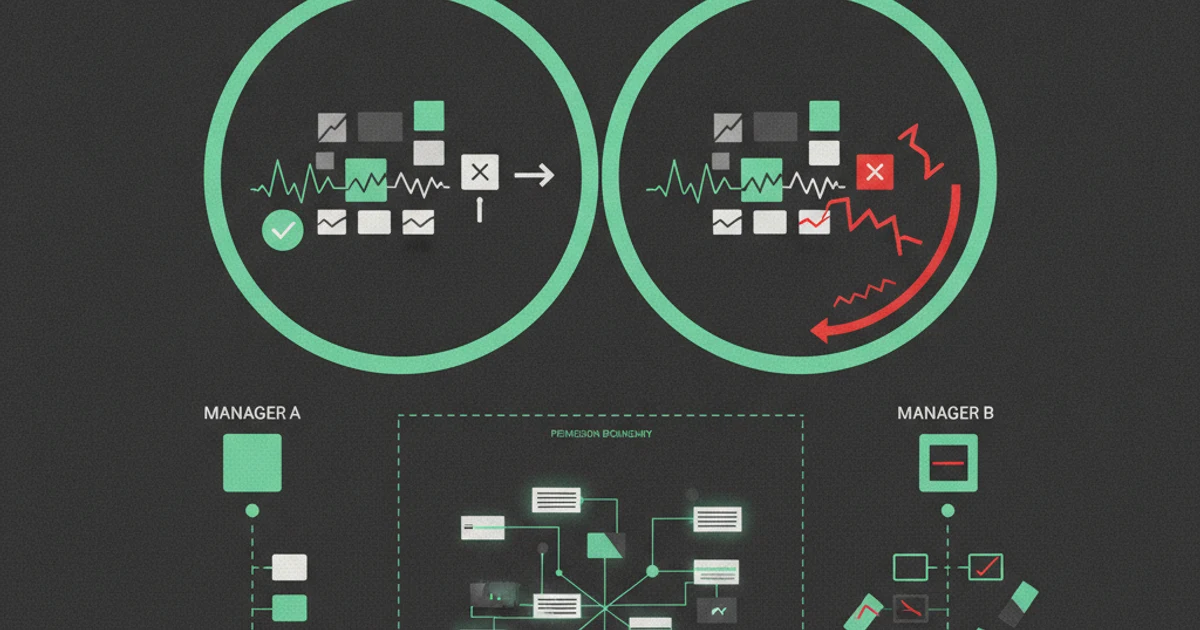
This research addresses the challenge through a bounded scenario: two supervisors reviewing a blinded sample of fictional CRM-cleanup records completed under one stable instruction set. The objective is to determine whether observed score changes reflect assistant learning, task mix, or a moving review standard. By isolating the variable of reviewer consistency, teams can gain insights into the drivers of performance evaluation results and make informed decisions regarding virtual-assistant development and process refinement.
| Measure | Numerator | Denominator/Category | Interpretation |
|---|---|---|---|
| Exact Agreement | Number of blinded double-review records with identical scores from both supervisors | Total number of blinded double-review records | Higher percentage indicates greater consistency in scoring standards. |
| Severity-Weighted Disagreement | Sum of absolute score differences, weighted by magnitude of difference (e.g., small vs. large deviation) | Total possible weighted disagreement for all records | Lower value indicates less impactful or less frequent disagreement between supervisors. |
| Reason-Code Agreement | Number of records where supervisors cite the same primary reason code for a score (e.g., 'data accuracy issue') | Total number of blinded double-review records where reason codes are provided | Higher percentage indicates shared understanding of performance criteria and common issues. |
| Adjudication Frequency | Number of records requiring a third-party review due to significant disagreement | Total number of blinded double-review records | Lower frequency suggests that initial review standards are sufficiently aligned, reducing overhead. |
Research design and methodology for detecting drift
The methodology for addressing reviewer drift in virtual-assistant onboarding is based on documentary synthesis, drawing upon established principles from measurement science and human resources. Guidance from the NIST/SEMATECH e-Handbook on Measurement Process Characterization (2012) informs the understanding of how to separate variability attributable to the measurement system (reviewers) from variability attributable to the item being measured (virtual assistant's work). This source guidance helps frame the problem as one of measurement system reproducibility, where different appraisers should ideally yield the same results.
The unit of analysis in this framework is the blinded double-review record. This means that each piece of early virtual-assistant work is independently scored by two different supervisors, and neither supervisor is aware of the other's score or the identity of the virtual assistant. This blinding is important for minimizing bias and supporting supervisors in applying their standards without influence from external factors or prior knowledge. The goal is to observe the natural variation in how standards are applied, providing a signal of potential drift.
For the purpose of detecting reviewer drift, the specific work product under review consists of fictional CRM-cleanup records completed under one stable instruction set. This controlled environment is important. By using a 'stable instruction set,' OnboardingEmployees analysis supports the virtual assistant's task understanding and the expected output remaining constant, which reduces a source of variability. The 'fictional CRM-cleanup records' represent a common, entry-level virtual-assistant task that is typically well-defined and quantifiable, making it suitable for objective evaluation.
Understanding the bounded scenario in detail
The bounded scenario, involving two supervisors reviewing a blinded sample of fictional CRM-cleanup records completed under one stable instruction set, is designed to isolate reviewer variability. This scenario specifically targets early virtual-assistant work, which is typically characterized by repetitive, structured tasks where performance expectations can be clearly defined. The use of 'fictional' records helps prevent exposure of real client data, supporting security and privacy protocols while still allowing for realistic task simulation.
CRM-cleanup tasks are particularly suitable for this analysis because they often involve discrete actions like updating contact information, categorizing leads, or removing duplicate entries. These tasks provide clear criteria for evaluation (e.g., accuracy, completeness, adherence to formatting rules) that can be consistently assessed. The 'one stable instruction set' is a cornerstone of this design; any changes to task instructions could introduce variability in virtual-assistant performance or supervisor expectations, confounding the measurement of reviewer drift. By holding the instructions constant, any significant scoring discrepancies are more likely attributable to the reviewers themselves.
The 'blinded sample' aspect is also important. Supervisors are presented with work samples without knowing which virtual assistant completed them or who the other reviewer is. This prevents 'halo effects' or 'horn effects' where a supervisor's general impression of a virtual assistant influences specific task ratings. The O*NET Resource Center's Content Model (2026) provides source guidance for grounding task and work-activity definitions. OnboardingEmployees analysis uses this to support defining the CRM-cleanup tasks in a way that aligns with broadly recognized occupational frameworks, rather than relying solely on internal, potentially ambiguous, employer-specific standards.
Identifying potential confounders and their mitigation
When assessing differences in performance scores, it is important to distinguish between true reviewer drift and other factors that might cause discrepancies. Two primary confounders are assistant learning and task mix variability. Assistant learning refers to the genuine improvement or decline in a virtual assistant's skill over time. If a virtual assistant consistently improves, their scores should naturally rise. Task mix refers to variations in the difficulty or nature of tasks assigned, even within the same category like 'CRM cleanup.' A more complex set of records might legitimately result in lower scores, regardless of reviewer consistency.
The bounded scenario is designed to mitigate these confounders. By reviewing a 'blinded sample' of 'fictional CRM-cleanup records' completed under 'one stable instruction set,' the influence of assistant learning and task mix is minimized. Since the samples are blinded, supervisors are not evaluating a virtual assistant's progress over time, but rather a snapshot of work. The 'stable instruction set' supports that the underlying task requirements do not change, addressing task mix variability. The 'fictional' nature allows for the creation of samples with controlled difficulty levels, further standardizing the input.
OnboardingEmployees analysis notes that this framework is designed to measure the consistency of the review process itself, rather than directly assessing individual virtual-assistant performance. While the broader goal is to improve virtual-assistant onboarding, this particular measurement system aims to assess the fairness and reliability of the evaluation mechanism. By isolating reviewer drift, teams can consider that observed changes in virtual-assistant performance scores are more likely due to actual skill development or specific task challenges, rather than arbitrary shifts in review standards.
Measures of agreement and disagreement
To quantify reviewer drift, the analysis proposes four distinct measures: exact agreement, severity-weighted disagreement, reason-code agreement, and adjudication frequency. These measures, informed by source guidance on measurement system characterization from the NIST/SEMATECH e-Handbook (2012), provide a comprehensive view of consistency. The NIST guidance separates questions of repeatability (consistent results from one reviewer over time) and reproducibility (consistent results across multiple reviewers), with the latter being the focus of reviewer drift.
Exact agreement is a straightforward measure where the numerator is the number of blinded double-review records with identical scores from both supervisors, and the denominator is the total number of blinded double-review records. A higher percentage of exact agreement indicates greater consistency. Severity-weighted disagreement offers a more nuanced view; the numerator is the sum of absolute score differences, weighted by the magnitude of the difference (e.g., a one-point difference might be weighted less severely than a five-point difference on a ten-point scale). The denominator is the total possible weighted disagreement for all records. OnboardingEmployees analysis interprets a lower weighted disagreement as indicating less impactful or less frequent inconsistencies.
Reason-code agreement focuses on the qualitative aspects of feedback. The numerator is the number of records where supervisors cite the same primary reason code for a given score (e.g., 'data accuracy issue' or 'incomplete entry'), while the denominator is the total number of records where reason codes are provided. A higher percentage suggests a shared understanding of performance criteria and common issues. Adjudication frequency measures the number of records requiring a third-party review due to significant disagreement, with the total number of blinded double-review records as the denominator. OnboardingEmployees analysis views a lower adjudication frequency as evidence that initial review standards are sufficiently aligned, reducing the need for escalations.
Establishing review standards and structured assessment
Supporting consistent review standards for virtual-assistant onboarding draws parallels from structured assessment methodologies. The U.S. Office of Personnel Management's Structured Interviews guidance (2026) offers source guidance on standard questions, common rating scales, and trained assessors to improve consistency. While applied to interviews, these principles are directly transferable to performance review contexts. For virtual-assistant onboarding, this means developing clear, objective criteria for each task and supporting thorough training for supervisors in applying these criteria uniformly.
OnboardingEmployees analysis suggests implementing specific rating scale types, such as behaviorally anchored rating scales (BARS), where each score point is defined by observable behaviors or outcomes relevant to CRM-cleanup tasks. For example, a score of '3' for accuracy might correspond to 'Minor data entry errors, easily corrected,' while a '5' means 'No detectable data entry errors.' Supervisor training is important, covering not only the mechanics of the rating scale but also calibration exercises where supervisors jointly score a set of samples and discuss their rationale, identifying and resolving discrepancies before live reviews commence.
Addressing the 'moving review standard' component of the management decision involves specific measures. Regular recalibration sessions for supervisors, perhaps quarterly or bi-annually, can help prevent standards from drifting. These sessions would involve re-reviewing a standard set of work samples and comparing current ratings against established benchmarks. This continuous feedback loop, informed by the measures of agreement and disagreement, helps maintain the integrity of the review process and supports that virtual assistants are evaluated against a stable and fair benchmark throughout their onboarding journey.
Evidence-led conclusion
The source guidance supports stable measures, defined work activities, common rating scales, and trained assessors. It does not establish a universal agreement threshold for virtual-assistant onboarding. Each team must predefine an investigation rule that fits its scale and consequence classes before seeing results.
Exact agreement, severity-weighted disagreement, reason-code agreement, and adjudication frequency answer different questions. They become useful only when both reviewers score the same blinded work under the same instructions. Task-mix or instruction changes must be shown separately rather than attributed to reviewer drift.
The evidence-led conclusion is that reviewer drift can be detected through repeated blinded double review, not through an assistant's average score alone. Disagreement should trigger examination of the rating system and source work before any conclusion about the assistant. Employment and other consequential decisions remain with authorized people and require evidence beyond this diagnostic record.
Sources and methodology
This research employs a documentary synthesis methodology, integrating guidance from three authoritative external sources: the NIST/SEMATECH e-Handbook for measurement process characterization, the O*NET Resource Center's Content Model for task definition, and the U.S. Office of Personnel Management's Structured Interviews guidance for consistent assessment. This approach supports the development of a structured framework for measuring reviewer drift in virtual-assistant onboarding by applying established measurement principles and occupational analysis tools to a specific operational challenge. The synthesis distinguishes between established source guidance and proposed OnboardingEmployees analysis, metrics, thresholds, scenarios, and interpretations. The evidence scope is limited to the theoretical application of these principles to a defined scenario, focusing on the design of a measurement system rather than reporting empirical results.
- NIST/SEMATECH e-Handbook, Measurement Process Characterization2012. Measurement-system guidance used to separate repeatability and reproducibility questions.
- O*NET Resource Center, Content Model2026. Public occupational framework for grounding task and work-activity definitions without treating them as employer-specific standards.
- U.S. Office of Personnel Management, Structured Interviews2026. Guidance on standard questions, common rating scales, and trained assessors to improve consistency.
Source count: 3. Last verification date: August 21, 2026.
Related research
FAQ
What is reviewer drift in the context of virtual-assistant onboarding?
Reviewer drift refers to inconsistencies in how different supervisors evaluate the same type of virtual-assistant work, or how one supervisor's standards change over time. It can lead to unfair or unreliable performance assessments during the onboarding phase.
Why is it important to measure reviewer drift during virtual-assistant onboarding?
Measuring reviewer drift supports virtual assistants receiving consistent and fair feedback, helping to accurately gauge their learning progress. It helps prevent misinterpretations of performance that could be attributed to a virtual assistant's skill when the issue is actually with the evaluation standard.
What is a 'blinded double-review record' and why is it used?
A blinded double-review record means two different supervisors independently score the same piece of virtual-assistant work without knowing each other's scores or the virtual assistant's identity. This method reduces bias and helps isolate inconsistencies in the review process itself.
How do the proposed measures (exact agreement, severity-weighted disagreement, etc.) help detect drift?
These measures quantify different aspects of reviewer consistency. Exact agreement shows overall score alignment. Severity-weighted disagreement notes the impact of discrepancies. Reason-code agreement indicates shared understanding of performance criteria. Adjudication frequency points to the need for third-party intervention, all signaling potential drift.
Can detecting reviewer drift help distinguish between assistant learning and a moving review standard?
Yes. If reviewer agreement measures are consistently high, then score changes are more likely due to actual virtual-assistant learning or task characteristics. If agreement measures are low, it suggests a moving review standard, indicating the need to address the review process itself rather than the virtual assistant's performance.
Review the full research library, compare cluster coverage inside recruiting operations, and pair these findings with our VA candidate screening support.