Key takeaways
- Structured provenance tracking for virtual assistant work clarifies the origin of information, which aids in validating early outputs.
- Implementing W3C PROV-O concepts can provide a standardized framework for documenting virtual assistant data flows, supporting consistent record-keeping.
- Defining specific measures like source-link completeness and review reconstruction time allows for quantifiable assessment of auditability improvements.
- Reserving sensitive decisions for authorized personnel while enabling virtual assistants with auditable data preparation can support onboarding efficiency.
Table of contents
- The research question and context
- Documentary synthesis and evidence scope
- The bounded scenario in depth
- Provenance principles for virtual assistants
- Measures defined: source-link completeness and version traceability
- Measures defined: unsupported-field count and review reconstruction time
- Confounders, limitations, and reserved decisions
- Evidence-led conclusion
The research question and context
Does recording the source, version, and retrieval time behind each early-work decision make virtual-assistant onboarding evidence easier to audit? This central question guides an exploration into the practical application of provenance principles within virtual-assistant operations, specifically during the onboarding phase. Effective onboarding for virtual assistants involves training on tasks and establishing clear processes for data handling and accountability from the outset.
The use of virtual assistants for preparatory data work, especially in areas like market research or prospect record generation, requires methods to confirm the reliability and origin of their outputs. Without clear provenance, verifying the accuracy of information, or understanding its context, becomes a time-consuming and prone to error. This can hinder subsequent management decisions.
OnboardingEmployees analysis suggests that integrating provenance tracking into the initial training and workflow of virtual assistants can help mitigate these risks. By making explicit the origin of every piece of information, organizations can establish a basis for trust and transparency, supporting the scaling of virtual assistant contributions while maintaining quality control.
| Auditability Dimension | Definition | OnboardingEmployees Metric | Example for VA |
|---|---|---|---|
| Source Traceability | Ability to follow information from output back to its origin. | Source-link completeness (%) | Percentage of prospect record fields with verifiable source URLs. |
| Version Consistency | Assurance that the specific data version used is identifiable. | Version traceability (Y/N) | Indication of specific date/time for public source retrieval. |
| Data Integrity | Confirmation that information is unaltered from its source. | Unsupported-field count | Number of data fields lacking documented source or version. |
| Review Efficiency | Time required to validate output against original sources. | Review reconstruction time (min) | Time taken by a reviewer to verify all data points from sources. |
Documentary synthesis and evidence scope
This research employs a documentary synthesis methodology, integrating established guidance from NIST Special Publications and W3C recommendations. The approach combines insights from NIST SP 800-92, focusing on reliable event records and log management, with NIST SP 800-137, which outlines methods for information security continuous monitoring, including evidence collection and analysis. Additionally, the W3C PROV-O specification provides a standardized model for representing provenance relationships.
The evidence scope is limited to a specific scenario: a research virtual assistant preparing a fictional prospect record from approved public sources without making outreach decisions. This focus allows for a detailed examination of provenance tracking in a controlled, non-sensitive context, reducing variables related to client interaction or privileged data handling. OnboardingEmployees analysis uses these foundational documents to construct a conceptual framework developed for virtual assistant onboarding.
Proposed metrics, thresholds, scenarios, and interpretations within this document represent OnboardingEmployees analysis, applying the broader principles of information security and data provenance to the context of virtual assistant work. Source guidance from NIST and W3C is explicitly identified to differentiate between established best practices and their specific application within the OnboardingEmployees framework for virtual assistant auditability.
The bounded scenario in depth
The bounded scenario centers on a research virtual assistant tasked with compiling a fictional prospect record. This involves gathering publicly available information such as company name, industry, headquarters location, and publicly reported revenue figures. The assistant is strictly limited to approved public sources like company websites, reputable industry directories, and financial news archives. No interaction with prospects or access to proprietary databases is permitted within this scenario.
A key constraint of this scenario is that the virtual assistant is prohibited from making any outreach decisions. Their role is preparatory: to consolidate verified public data into a structured record format. Any subsequent decisions regarding contact, lead qualification, or resource allocation remain reserved for authorized human personnel. This strict division of labor notes the importance of auditable data input.
The management decision under consideration is whether the assistant may prepare a larger batch of these prospect records once initial work is approved, while all approval and contact decisions remain reserved. This examines potential efficiency gains from enhanced auditability. If the provenance chain is sufficiently clear and complete, management can scale the data preparation phase without compromising accuracy or control over sensitive subsequent actions.
Provenance principles for virtual assistants
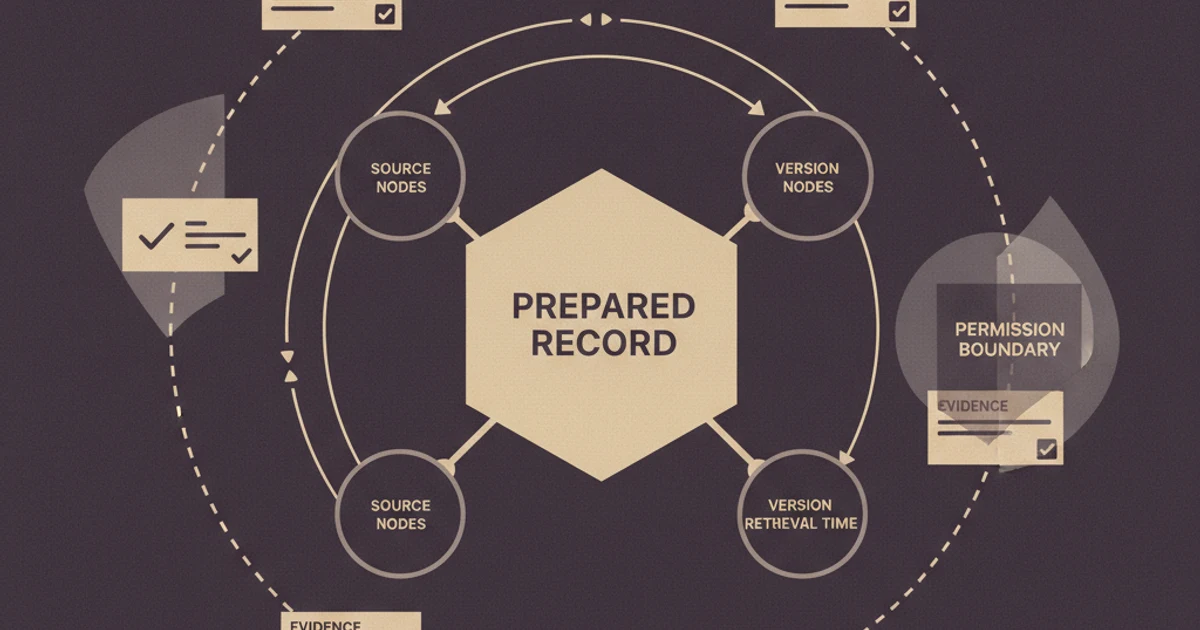
Source guidance from W3C PROV-O provides a conceptual model for representing provenance relationships, defining entities, activities, and agents involved in data creation and transformation. For virtual assistants, this translates to documenting which assistant (agent) performed which data retrieval (activity) to produce a specific data point (entity) in the prospect record. This structured approach defines explicit relationships beyond simple logging.
NIST SP 800-92, Guide to Computer Security Log Management, offers guidance on creating reliable event records, which can be adapted for virtual assistant activity. While not directly about data provenance, its principles for log management infrastructure and review responsibilities are relevant. OnboardingEmployees analysis applies this by proposing that each data retrieval action by a virtual assistant should generate an auditable record, akin to a security log entry, detailing the source accessed, the specific version of content viewed, and the exact timestamp of retrieval.
Integrating these principles supports the traceability of every piece of information in the prospect record. This means more than knowing where the data came from, but when it was retrieved and what specific version of that source was observed. This level of detail, as proposed by OnboardingEmployees analysis, is important for reconstructing the assistant's work and verifying accuracy, particularly when public sources frequently update their content.
Measures defined: source-link completeness and version traceability
The unit of analysis for this research is the source-to-output provenance chain for each data point within the fictional prospect record. One key measure is `source-link completeness`. This metric quantifies the proportion of data fields in the prospect record that are directly linked to their original public source via a verifiable URL. For example, if a record has 10 fields and 9 have valid, accessible source URLs, the completeness is 90%.
OnboardingEmployees analysis defines the numerator for source-link completeness as the count of prospect record fields for which a valid, accessible, and direct URL to the public source is provided by the virtual assistant. The denominator is the total number of data fields expected to be populated from public sources. A threshold of 100% completeness is desirable, indicating full traceability of all primary data points.
Another measure is `version traceability`. This assesses whether the specific version of the source material observed by the virtual assistant can be identified. For dynamic web pages, this might involve a timestamp, an archive link, or a direct quote with a precise date. OnboardingEmployees analysis categorizes this as a binary measure (Yes/No) for each sourced field, where 'Yes' indicates that the specific version or retrieval time is sufficiently documented to reconstruct the exact data viewed by the assistant, and 'No' indicates otherwise.
Measures defined: unsupported-field count and review reconstruction time
The `unsupported-field count` indicates data integrity issues or gaps in provenance documentation. This measure tallies the number of data fields within the prospect record that lack either a verifiable source link, documented version information, or both. OnboardingEmployees analysis considers any field without complete provenance as "unsupported," showing areas where the assistant's work cannot be fully validated.
The numerator for unsupported-field count is the number of fields in the prospect record where source-link completeness is less than 100% or version traceability is 'No'. The denominator is the total number of fields in the record. A low count is preferable, ideally zero, indicating a high degree of data integrity and audibility. This measure directly informs the management decision regarding batch processing, as a high count would necessitate individual review.
Finally, `review reconstruction time` measures the efficiency of the audit process. This metric quantifies the total time, in minutes, required by an authorized reviewer to independently verify all data points in a prospect record by following the provided source links and version information. OnboardingEmployees analysis suggests that comprehensive provenance documentation can reduce this time, as reviewers spend less effort searching for original sources or clarifying discrepancies. This measure is a reflection of the "easier to audit" aspect of the research question.
Confounders, limitations, and reserved decisions
Several confounders could influence the perceived auditability, even with detailed provenance. The inherent variability of public web sources, including content changes or link rot, can complicate verification, regardless of initial documentation. Furthermore, the skill level and diligence of the virtual assistant in accurately recording provenance elements are important. OnboardingEmployees analysis acknowledges that training quality directly impacts the initial capture of provenance data.
This research has specific limitations. It focuses solely on data compilation from approved public sources, excluding complex tasks involving data interpretation, synthesis, or creative drafting. The bounded scenario does not involve real client data or live customer interactions, thus avoiding the complexities of confidentiality and real-world consequences. It is a conceptual framework, not an empirical study with performance data.
It is important that certain decisions remain reserved for authorized human personnel. Employment decisions, legal interpretations, security protocols, financial transactions, direct customer contact, credential management, and any irreversible actions must not be delegated to virtual assistants. The role of the virtual assistant, even with enhanced provenance, is to prepare auditable evidence, not to make or enact significant judgments.
Evidence-led conclusion
NIST guidance supports reliable event records and defined information needs, while W3C PROV-O supplies a model for provenance relationships. These sources do not measure virtual-assistant onboarding outcomes. The proposed source-to-output chain is an application of those ideas to a bounded preparatory task.
Source-link completeness and version traceability show whether a reviewer can locate the evidence available to the assistant. Unsupported-field count shows where that chain breaks. Review reconstruction time records reviewer effort, but it should not be interpreted without task size, source stability, and reviewer experience.
The evidence-led answer is that recording source, version, and retrieval time makes reconstruction possible and therefore gives a team a direct way to test auditability. Whether it reduces review time or supports a larger batch must be measured locally. Complete provenance does not validate the underlying claim by itself and does not transfer approval, outreach, financial, security, credential, or irreversible decisions to the assistant.
Sources and methodology
This research employs a documentary synthesis methodology, integrating guidance from NIST Special Publications 800-92 and 800-137, alongside the W3C PROV-O recommendation, to construct a framework for evaluating virtual-assistant work auditability. The evidence scope is intentionally narrow, focusing on the structured onboarding of virtual assistants performing data compilation from approved public sources. OnboardingEmployees analysis applies these established principles to the specific context of virtual-assistant role definition, screening, staffing coordination, and structured onboarding. Proposed metrics, thresholds, scenarios, and interpretations presented here represent OnboardingEmployees analysis, while references to NIST and W3C documents denote source guidance on security logging, continuous monitoring, and provenance representation. This approach allows for the development of a conceptual model for enhanced auditability without requiring live system implementation or collection of performance data.
- NIST SP 800-92, Guide to Computer Security Log Management2006. Guidance on reliable event records, log management infrastructure, and review responsibilities.
- NIST SP 800-137, Information Security Continuous Monitoring2011. Guidance on defining information needs, collecting evidence, analyzing results, and supporting decisions.
- W3C PROV-O2013. A W3C recommendation for representing entities, activities, agents, and provenance relationships.
Source count: 3. Last verification date: August 21, 2026.
Related research
FAQ
What is source provenance in the context of virtual assistants?
Source provenance refers to the detailed documentation of the origin, version, and retrieval time for every piece of information a virtual assistant uses or generates. It creates a verifiable chain of custody for data.
Why is provenance tracking important for virtual assistant onboarding?
During onboarding, provenance tracking establishes a foundation for accuracy and accountability. It helps new virtual assistants learn best practices for data handling and enables managers to easily audit and verify the reliability of early work outputs.
How does this research define "auditability" for virtual assistant work?
Auditability is defined through quantifiable measures such as source-link completeness, the ability to trace the specific version of a source, the count of data fields lacking supporting provenance, and the time required for a reviewer to reconstruct the work.
What kind of virtual assistant tasks are covered by this research?
This research specifically focuses on preparatory tasks like compiling fictional prospect records from approved public sources. It excludes any tasks involving direct customer contact, decision-making, or access to sensitive proprietary information.
Does enhanced provenance mean virtual assistants can make critical decisions?
No. Even with enhanced provenance, critical decisions related to employment, legal matters, security, finance, customer contact, or irreversible actions must always remain reserved for authorized human personnel. Provenance enhances data preparation, not decision-making authority.
Review the full research library, compare cluster coverage inside recruiting operations, and pair these findings with our VA candidate screening support.